            |
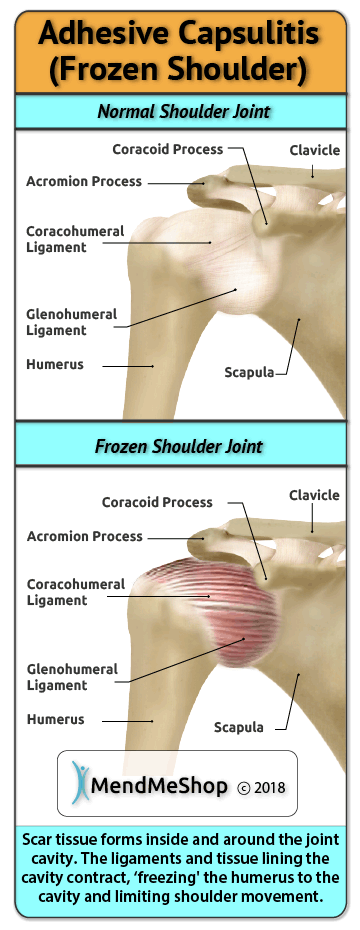
 If any of those statements are true for you or you're suffering from on-going pain on the outside of your shoulder then you might have an injury called "shoulder bursitis" - this is a very real injury (and is typically very painful) affecting the bursa sac in your shoulder. It can happen to anyone who regularly has repetitive shoulder movements as part of your job, or sports related activities such as swimming or tennis. Shoulder bursitis is one of those injuries that can really bring down the quality of your life quite quickly. Anyone - young or old - can suffer from this injury, and if you're active this condition will keep you from doing the things you love to do. The pain that comes from this will start interrupting your normal daily tasks and make living life harder than it really needs to be. What are Shoulder Bursae?Bursae (plural for bursa) are flattened sacs of fluid that function as cushions between your bones and the muscles (deep bursae) or bones and tendons (superficial bursae) to reduce friction and allow your soft tissue to slide over bone easily during muscle use. They are lined with synovial tissue that secrete fluid, rich in protein and collagen, and act as the lubricant between areas in your body where friction (rubbing) is greatest. In amongst your bones, muscles and tendons in the shoulder there are 8 bursae, the most of any single joint in your body. The major bursae in your shoulder include: the subscapular bursa, the subdeltoid bursa, the subacromial bursa, and the subcoracoid bursa. The subscapular bursa is located between the tendon of the subscapularis muscle and the shoulder joint capsule. The subcoracoid bursa sits between the coracoid process of the scapula and the shoulder joint capsule. The subacromial bursa is situated below the acromion process and above the greater tubercle of the humerus lessening the friction when you move your arm or raise it overhead. The subdeltoid bursa is located between the deltoid muscle and the shoulder joint cavity and is usually joined to the subacromial bursa. What is Shoulder Bursitis?Subacromial Bursitis is a general medical term used to describe inflammation of the bursa of the shoulder. When pressure or friction is too great, excess fluid can build up in the bursa sac causing swelling and inflammation. When a bursa becomes inflamed, moving the shoulder becomes very painful and movement can be difficult. Any actions that put pressure on the inflamed bursa can increase irritation and cause further inflammation and pain. 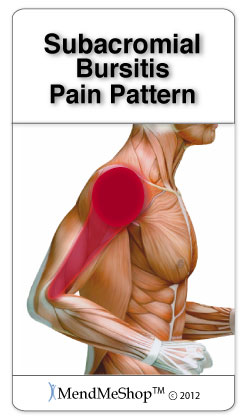 Your bursae play an important role in leading a healthy, active life. When the bursae are not irritated and working properly, your joints move smoothly and painlessly. However, when a bursa becomes swollen and inflamed, the condition is known as bursitis. As you know, when you suffer from bursitis you will experience pain during physical activity. Although all of the bursa in the shoulder can become inflamed due to trauma, infection or other conditions, the subacromial bursa is the most commonly inflamed. Frequently, bursitis in the subacromial bursa occurs with tendonitis in the supraspinatus tendon, although you can experience these conditions independently. Since the subacromial bursa and subdeltoid bursa are usually joined together, inflammation in one usually results in inflammation of the other. Over-straining, infection, abnormal bone growth or trauma in the rotator cuff can cause rubbing in your shoulder joint, inflaming the tissue in the area. Even mild inflammation of your tendons or bursa can produce redness, swelling, and soreness. Failure to treat the inflammation can lead to bursitis and/or tendonitis. If this occurs, the bursa or tendon can become enlarged and the area between the acromion process and the top of the humerus (the subacromial space) may decrease causing the bursa or tendon to rub against the acromion. 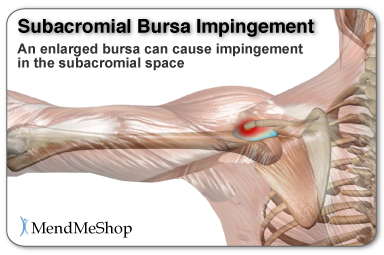 If the space becomes too crowded, the acromion can begin to pinch the bursa or tendon (impingement) when your arm is raised in a forward reaching or overhead position causing further irritation and swelling. This condition is often referred to as swimmer's shoulder, pitcher's shoulder, tennis shoulder, or shoulder impingement syndrome. This impingement can cause further inflammation in the bursa. In addition, degeneration of the tendon can occur which frequently results in a major rotator cuff strain and/or tear. If this continues, your pain will get worse and your tendon may split or completely tear away from the bone. Without prompt, proper treatment of bursitis with a conservative treatment protocol to heal this inflamed soft tissue, you may experience severe tissue damage and surgery may be necessary. Bursitis in the shoulder is often due to overuse or repetitive actions common in athletes or workers who use frequent overhead arm movements such as throwing a ball, swinging a racket, swimming, lifting weights, dusting high shelves, painting, or completing manual labor tasks. It can also result from something simple - like an awkward fall or an attempt to lift something up high with a weakened shoulder. Shoulder bursitis most commonly occurs in people older than 40 years of age and/or have bone spurs on one of their shoulder bones. However, these injuries can also affect younger people who often partake in new or repetitive activities, are already injured, and/or have chronic weakness in their shoulder. Are You Sure It Is Shoulder Bursitis?Pain, swelling and inflammation in your shoulder could mean that you have shoulder bursitis. It's also important to consider that there are other conditions that might cause pain in your shoulder as well. Our shoulders are very complicated joints with 6 major bones, ligaments connecting the bones, muscles in the front, back, top and side of our shoulders and tendons connecting those muscles to bone. With so many parts to the shoulder you can easily have a different injury than bursitis, or even suffer from more than 1 injury at a time. Some other shoulder injuries include: shoulder tendonitis, impingement syndrome, and frozen shoulder. 
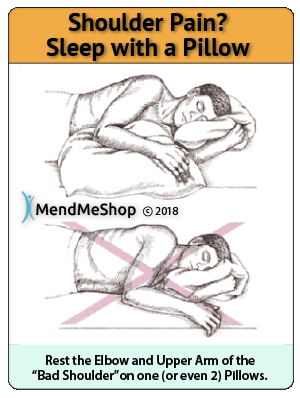
 Calcification of the bursa sac can also cause inflammation from within the bursa. What Causes Shoulder Bursitis?People older than 40 years of age are most susceptible to shoulder overuse injuries, which can easily lead to bursitis. Younger people who participate in repetitive activities, are already injured, and/or have chronic weakness in the shoulder are also at greater risk of experiencing bursitis. There is also a higher incidence of shoulder injuries among women.  Repetitive overhead shoulder movements, especially if they are weight bearing, may cause fatigue or general weakness in the shoulder muscles and tendons. As a result, your shoulder joint could become misaligned causing more pressure on the subacromial bursa. Shoulder over-straining can lead to inflammation in your joint, which can result in tendinitis and bursitis. You can experience these conditions independently or simultaneously. Without prompt treatment of inflammation in the rotator cuff, impingement (pinching of the tendon and bursa) may occur and cause degeneration in the tendon. Acute bursitis is often due to overuse or repetitive actions common in athletes or workers who use frequent overhead arm movements such as throwing a ball, swinging a racket, swimming, lifting weights, dusting high shelves, painting, or completing manual labor tasks. Bursitis in the shoulder is often referred to as Swimmer's Shoulder, Pitcher's Shoulder, Tennis Shoulder, or Shoulder Impingement Syndrome. Symptoms of Shoulder BursitisThe symptoms of subacromial bursitis are similar to the symptoms of bursitis that occur in other joints of the body; pain, limited range of motion, weakness, difficulties sleeping, swelling and tenderness, and possibly a fever if the bursa is infected. 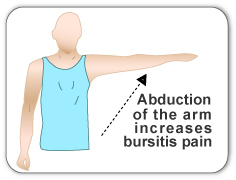
 How Do I Diagnose Shoulder Bursitis?The best way to diagnose this condition is with a quick visit to the your doctor for a physical examination of your shoulder. He/she will inquire about the intensity of your present pain, the duration of your symptoms and the limitations you are experiencing. Details about what instigated the problem, when it started, and whether or not you have ever had treatments for this or a similar condition in the past, are very helpful in assessing your injury.  Are you having trouble using or moving your shoulder? You will generally be asked to complete a series of movements to measure your active (performed by you) and passive (performed by your examiner) range of motion. These movements will test any possible shoulder impingements, as well as your shoulder strength, joint stability, and location of tenderness. A sign that you may have subacromial bursitis is acute pain when trying to reach the affected arm behind you towards the lower back, as if to get something out of your back pocket. You would also experience pain when reaching above your head, as you would when putting something on a high shelf. If you feel sharp pain with both of these motions you may have shoulder bursitis and/or other related conditions and should see a doctor. 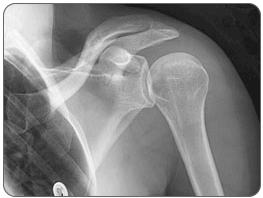 A physical examination will be performed to determine if you have any signs of shoulder bursitis or other shoulder injury. He/she will visually assess and palpate (feel) the bones and soft tissue in both your shoulders to evaluate symmetry to recognize any differences. This will identify any abnormalities, such as mild or severe inflammation, bone deformities, atrophied muscles, redness and/or warmth on the skin. Sometimes, one set of symptoms can result in multiple diagnoses. An x-ray or MRI is often needed in order to diagnose if the shoulder is out of alignment or the extent of the soft tissue damage. Although rare, subacromial bursitis can be caused by an infection which is potentially serious. Your doctor will be able to rule this out as a possible cause. To learn more about Conservative Treatments for the Shoulder, click here to go to our Shoulder Treatment PageLearn More About Bursitis Injuries & TreatmentsI want to learn more about Post-Surgery Recovery I want to learn more about TShellz Wrap® Circulatory Boost I want to learn more about Ice & Heat: Which Is Better For Treatment? I want to learn more about Bursitis Treatments I want to learn more about Bursitis Surgery FREE SHIPPING ON ALL PRODUCTS CURRENTLY ENABLED |
        |